
Independently reviewed using official sources and practical use cases.

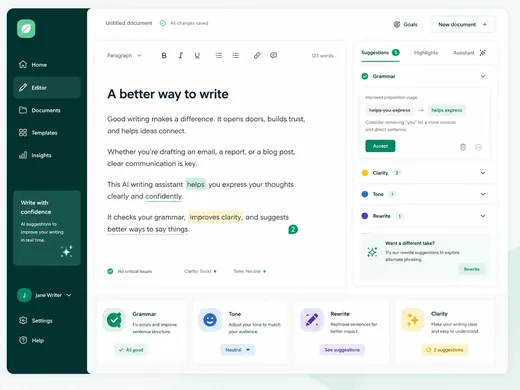
Identifies grammar, spelling, punctuation, and sentence-level mistakes while users write.
Suggests clearer and more concise wording and can rewrite complete sentences or paragraphs.
Evaluates how a message may sound and helps users adjust tone for different audiences.
Helps compose drafts, generate ideas, rewrite passages, and prepare replies using natural-language prompts.
Checks paid-plan content for potential plagiarism and text that may have been generated by AI.
Provides writing suggestions in English and 23 additional languages, although advanced feature availability varies by language.
✔ Correcting emails, messages, and documents
✔ Rewriting sentences for better clarity
✔ Adjusting tone for professional communication
✔ Drafting outlines, replies, and short content
✔ Checking originality before publishing or submitting work
Improve emails, documents, assignments, applications, articles, and online messages with real-time corrections, clarity suggestions, rewrites, and tone guidance.
Help teams communicate more consistently through shared style guidance, brand tones, reusable snippets, collaboration tools, and writing analytics.



Grammarly is one of the most practical AI writing assistants for users who want real-time help while writing emails, documents, messages, applications, articles, and professional content.
Its biggest advantage is that it does not require users to move every task into a chatbot. The tool works across many everyday writing environments and provides corrections, rewrites, tone suggestions, and generative AI help directly inside the writing workflow.
The free plan is useful for basic grammar, spelling, punctuation, tone detection, and limited AI prompts. The Pro plan is more valuable for users who need stronger rewrites, tone adjustments, originality checks, brand consistency, and higher AI usage limits.
It is not a full replacement for human editing. Important documents, specialist writing, legal or medical content, academic submissions, and brand-sensitive copy should still be reviewed carefully before publishing or sending.
Overall, Grammarly is a strong choice for everyday writing improvement, especially for students, professionals, writers, marketers, and teams. You can also explore more AI tools in the GoTaskAI AI Tools directory or read our ChatGPT, Claude AI, and Gemini reviews when you need broader AI assistance for writing, research, analysis, planning, and productivity.
Best for students, writers, professionals, marketers, job seekers, businesses, and teams that want regular help with proofreading, rewriting, tone, and written communication.
Always review important text manually, especially when meaning, factual accuracy, originality, specialist terminology, privacy, or legal and business communication matters.
It is used to correct grammar, spelling, and punctuation, improve clarity and tone, rewrite sentences, generate drafts, and review written communication across supported apps, browsers, and devices.
Yes. It offers a Free plan with essential writing corrections, tone detection, basic suggestions, and 100 generative AI prompts per month. Advanced rewriting, originality checks, and team features require a paid plan.
Grammarly Pro costs $30 per member per month, $60 per member every three months, or $144 per member per year. The annual option averages $12 per member per month, although prices, currencies, taxes, and promotions may vary by country.
Yes. In addition to English, it provides writing suggestions in 23 other languages. However, some generative AI, rewriting, and advanced features are available only in English or a smaller selection of supported languages.
Grammarly Pro includes plagiarism and AI-generated text detection tools. These tools can help identify possible issues, but their results should be reviewed carefully and should not be treated as definitive proof on their own.
No. It can identify many writing problems and suggest improvements, but it may misunderstand context, specialist terminology, factual claims, or the writer’s intended voice. Important academic, professional, legal, or public content still requires careful human review.