
Independently reviewed using official sources and 3 hands-on tests conducted by GoTaskAI in August 2026. Last verified: August 16, 2026.
Create visuals from text prompts using a broad selection of AI models and styles.
Use image, style, content, or character references when supported by the selected model.
Modify uploaded or generated images with adjustable reference-influence controls.
Remove backgrounds, upscale images, and refine generated assets within the platform.
Generate videos or animate visual assets using supported models and workflows.
Access image, video, audio, 3D, Flow State, Blueprints, and asset-library tools from one interface.
✔ Generate early product-advertising concepts before final design work.
✔ Explore visual styles, color palettes, compositions, and art directions.
✔ Create reference-guided variations from existing images and concepts.
✔ Prepare mockups by removing backgrounds or upscaling selected outputs.
✔ Develop storyboard frames and visual assets for video or social content.
Generate multiple visual directions quickly for campaigns, product concepts, social posts, or creative presentations. The strongest results come from using Leonardo.Ai for exploration and then refining the selected output manually.
Use cautiously for packaging, exact text, fixed object counts, and structural image edits. Our tests showed that visually attractive results may still ignore explicit instructions and require correction before professional use.



Leonardo.Ai earns a GoTaskAI Editorial Score of 3.6/5. It provides a broad and approachable creative workspace, but its polished-looking results can hide important instruction and accuracy failures.
Its strongest value is rapid visual ideation. The daily free allowance, broad model selection, reference options, editing tools, and additional video workflows make it useful for exploring several creative directions without paying first.
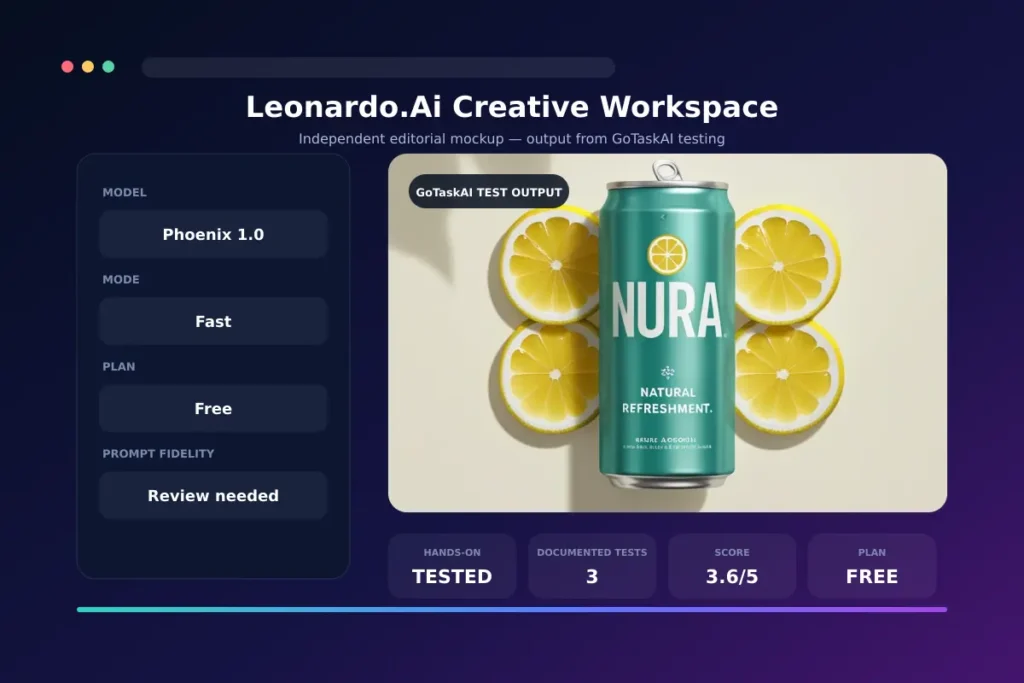
Across our three counted hands-on tests, the platform produced attractive product imagery but struggled with exact text, object counts, major image-to-image changes, and clean background removal. The best T1 output scored 7/10, while the complete T1 batch averaged 4.5/10.
The Free plan is useful for evaluation, but its generations are public. Leonardo retains broad rights to free-tier creations, although users receive a non-exclusive, royalty-free licence for commercial use; Private Mode and stronger ownership terms require a paid subscription.
We recommend Leonardo.Ai for creators and small teams that value fast experimentation and are prepared to review every result. Explore more options in the GoTaskAI AI Tools directory, including our Canva AI review and Runway review, before selecting a long-term creative platform.
Creators and small teams prioritizing fast visual ideation over exact production control.
Free-plan generations are public. Leonardo retains broad rights to them, although free users receive a non-exclusive, royalty-free commercial licence. Review every output for text, artifacts, brand accuracy, licensing, and privacy before use.
Yes. The Free plan provides 150 Fast Tokens per day, Basic quality settings, and access to image and video generation within the available token allowance. Free-plan creations are public.
Leonardo.Ai offers a Free plan at $0. Monthly individual plans currently start with Essential at $12, followed by Premium at $30 and Ultimate at $60, excluding tax; annual billing may provide savings of up to 20%.
Yes. Free users receive a non-exclusive, royalty-free commercial licence, although Leonardo retains broad rights to free-tier creations. Paid subscribers retain ownership and intellectual-property rights to generated images, subject to the applicable terms and third-party rights.
Free-plan generations are public. Private generations are available with paid individual plans, so users handling confidential or unreleased material should verify their plan before uploading or generating assets.
It can create attractive product visuals, but our testing found errors in object counts, labels, small text, and structural editing instructions. Branding and packaging outputs should always receive human review.
Results may vary by model and configuration. In our limited Phoenix 1.0 Fast diagnostic, all four outputs were unrelated to the requested Arabic product scene, so Arabic users should test their chosen model before depending on it.